 By Colin Connor23 January 20224 min read
Underwater What?
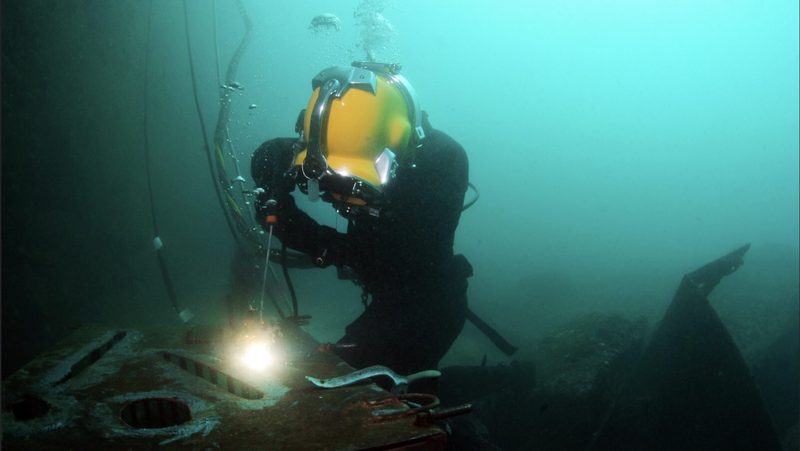
Underwater welding. The two words together sound like a contradictory statement. How could anything involving exposed electricity safely take place underwater?
Welding and water, electricity and fluid? It’s simply doesn’t sound right when hearing it for the first time. Under most circumstances, we see this mixture as a bad idea.
So Firstly, Let’s Identify, What is Underwater Welding?
Underwater welding has been around since the early 1930s and is still being performed in many parts of the world for the maintenance and repair of marine infrastructures that are partially or fully submerged in water.
Underwater welding is used in the repair of offshore structures and pipelines, ships, submarines, and even nuclear reactors.
The initial thought that comes to people’s minds when talking about underwater welding is the danger of mixing water and electricity. Indeed, this can be quite a risky task. Yet, many choose this career path for the excitement and challenges that come with the job.
How Does Underwater Welding Work?
So how is welding performed underwater? There are surprisingly a number of ways that welder-divers do it. After being given an assignment, project managers and engineers along with expert welder-divers choose between several types of underwater welding that will best suit their needs.
Here are the 2 most common underwater welding methods:
Wet Welding
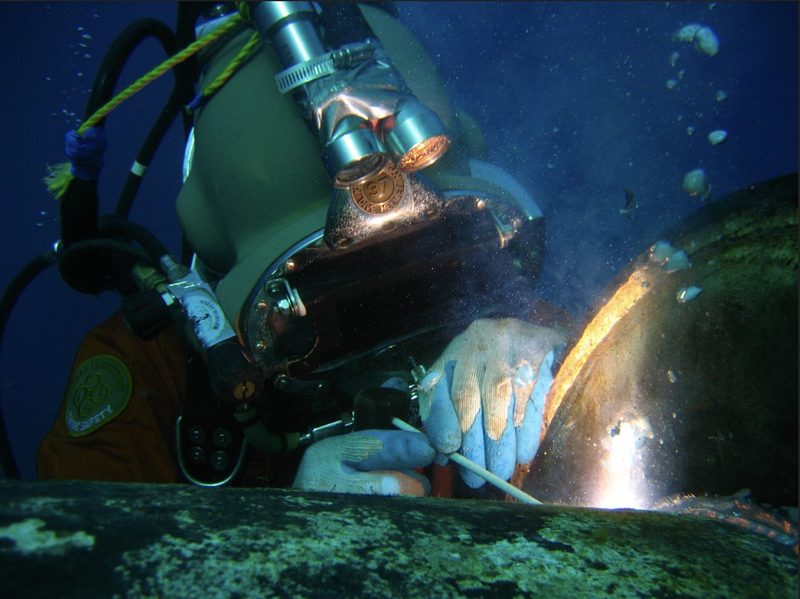
Similar to surface, or ‘topside’ welding, wet welding is a process that produces an electric arc between a coated electrode and the infrastructure being welded together. The electrical arc effectively melts the base metal whilst the burning electrode deposits weldment into the desired location.
The most cost-effective and versatile method that is called ‘Shield Metal Arc Welding’ abbreviated to (SMAW). This methods gets its name for the coating, or ‘shield’ that surrounds the electrode.
Advantages of Wet Welding
- The wet welding process is faster, cheaper and incredibly versatile than others
- There is no subsea habitat to install or maintain
- Diver-welders can be deployed directly onsite with minimal preparation
- Ease of access to weld spots
Disadvantages of Wet Welding
- This process is not generally used for high quality welds
- No control over work environment
- Diver-welders are exposed to the elements, sea currents and the restricted visibility of murky seas
Hyperbaric Welding
Hyperbaric welding (“hyper” = in excessive of, and “baric” = pressure) is a method of underwater welding that involves using a hyperbaric chamber, also know as a habitat.
A habit is a pressurized chamber that it sealed around an underwater structure which requires welding.
After dewatering, usually using a mixture of different gases, like helium and oxygen, internal repairs and welds can be carried out in dry, near-surface-like conditions.
Since the environment inside the chamber resembles those similar to topside, a number of welding techniques can be used. These range from Stick, Flux-Core and TIG.
Advantages of Hyperbaric Welding
- High-quality welds can be produced and inspected in a dry environment
- The weld site can be closely monitored and controlled
- Pre and Post heat treatment methods are possible
- Divers-welders can comfortably work in a dry atmosphere
- It’s cheaper than cropping and surfacing an entire asset, like an oilfield pipeline, mending it and then reinstalling subsea
Disadvantages of Hyperbaric Welding
- Costly setup and production costs
- Requires a large topside support team for habit monitoring
How Risky to Perform an Underwater Welding?
Generally speaking, wet welding can be considered a routine underwater operation. Therefore, risks can be minimized by preforming detailed Safety Analysis and conforming to strict safety working practices. Also, it is essential that before carrying out any work, the underwater welder check the surroundings for any obstructions, potential gas pockets or other safety hazards
That being said, and as to be expected, there are definitely some risks that come with handling electrical equipment underwater:
- Electrocution: The risk of electrocution is very real. It is imperative that diver-welders use equipment suitable for use in an underwater surroundings. Items such as the welding cables and stingers should be frequently checked for damages and should be discarded if damage incurs to the insulating jacket. Any exposure of the bare welding cable may result in leakage of electrical current in the water causing a potential injury.
- Explosions: Although it seems outlandish, explosions are very much a risk for underwater welders. Explosions can occur when gas pockets of hydrogen and oxygen are ignited. These are especially dangerous because the gas pockets are not visible and avoidable. That is why proper procedures should be followed all the equipment must be used only for its specified purpose, and very carefully at that.
- Drowning: If not careful electrocution and explosions could cause a diver to lose consciousness. If this happens, drowning is a very real possibility.
- Decompression sickness: Decompression sickness, also known as diver’s disease, is caused when divers inhale gases at increased pressures. It is always important to plan dives carefully and abide by the most updated decompression tables.
Conclusion
The advantages of underwater welding are largely of an economic nature, because underwater welding for marine maintenance and repair jobs bypasses the need to pull the structure out of the sea saving valuable time and potential dry docking costs.
Although it can be somewhat costly, underwater welding is generally quick, efficient, and easily deployable in almost any situation.
Our dive team is stocked with experienced professional diver-welders. They can be deployed in almost any sea conditions and can be mobilized for almost all projects at a moment’s notice. From welding doubler patches, attaching sacrificial anodes to rope guard reconstructions and structural hull repairs, our team can do it all!
We at TSS pride ourselves in delivering reliable and cost-effecting subsea solutions at affordable prices, always ensuring your vessel a prolonged period away from dry-docking.
 International Association of Classification Societies
